
Newsweek has contacted the Philippine and Chinese militaries with written requests for comment.
Why It Matters
Beijing claims sovereignty over almost the entire South China Sea, a critical waterway through which an estimated one-fifth of global maritime trade passes. These sweeping claims overlap with those of several neighbors, including the Philippines, a U.S. treaty ally.
Manila’s pushback against China’s growing footprint in its exclusive economic zone has led to increasingly unsafe and, at times, violent confrontations at sea.
What To Know
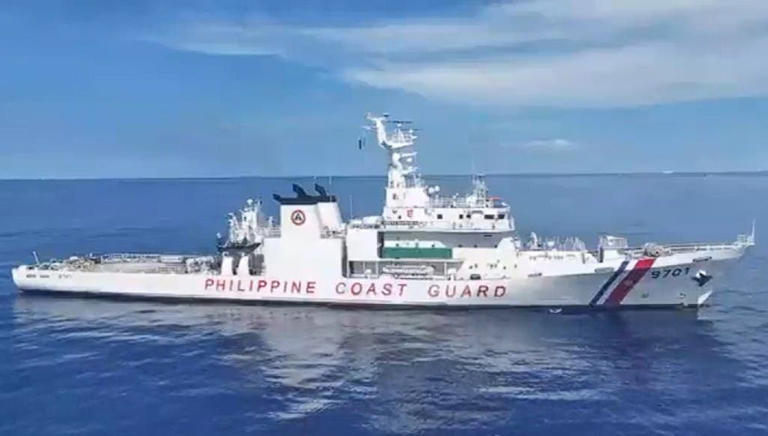
Chinese maritime forces once again sought to block a joint Philippine coast guard and Bureau of Fisheries and Aquatic Resources convoy tasked with delivering fuel and groceries to local fishermen, coast guard spokesperson Jay Tarriela wrote on X.
The “tense” encounters took place near two long-disputed areas within the Philippines’ maritime zone: Sabina Shoal—situated about 90 miles west of the Philippines’ westernmost province of Palawan—and Scarborough Shoal, traditionally a rich fishing ground for both Chinese and Filipino anglers.
According to Tarriela, the supply team encountered about 10 Chinese coast guard ships and another 10 vessels belonging to China’s “maritime militia” near both features. He added that People’s Liberation Army Navy helicopters and ships, including a “high-speed response boat,” were also spotted near Scarborough Shoal.
Tarriela accused Chinese vessels of carrying out “dangerous maneuvers and blocking actions” that delayed the supply mission and said Chinese coast guard ships again used water cannons to “threaten and intimidate Filipino fishermen.”
He added that, for the first time, China’s coast guard accused Manila of violating the “environmental reserve” that Beijing unilaterally declared over a large section of Scarborough Shoal last month, a move that drew protests from both Manila and Washington.
Despite the interference, Tarriela said the mission succeeded in handing supplies to almost 100 fishing vessels. Government personnel also facilitated the purchase of 30 tons’ worth of fresh fish, he added.
Western analysts view the growing presence of Chinese naval forces in these confrontations as a major escalation. Previously, China relied primarily on its coast guard and maritime militia to press territorial claims with lower risk of triggering armed conflict.
Recently, a Chinese navy destroyer reportedly collided with a Chinese coast guard ship during an encounter with a Philippine vessel. The coast guard cutter’s bow sustained heavy damage, and Philippine officials believed the incident left at least two Chinese crew members dead. Both sides blamed the other for unsafe navigation.
An international arbitral tribunal’s 2016 ruling largely sided with the Philippines, rejecting Beijing’s expansive claims on the South China Sea. China continues to dismiss the decision as invalid.
What People Are Saying
Admiral Ronnie Gil Gavan, the head of the Philippine coast guard, said in a statement: “My top priority is to safeguard [fishermen’s] livelihoods from any interference by the China Coast Guard and to ensure their rights as Filipinos are never suppressed by external bullying. We stand firmly with President Ferdinand Marcos Jr. in defending every square inch of our sovereign territory against any foreign power.”
Li Guoqiang, the deputy director of Chinese Academy of History, said, per state media outlet the Global Times: “Since the Yuan Dynasty government surveyed Huangyan Dao [Scarborough Shoal], the island has always been an inalienable part of China. It has not only witnessed China’s official surveying, mapping, and naming but also the fishing production of Chinese fishermen.”
What Happens Next
Neither side appears willing to back down. It remains to be seen how prominently China’s navy will feature in future standoffs as tensions continue to rise over disputed waters.

